
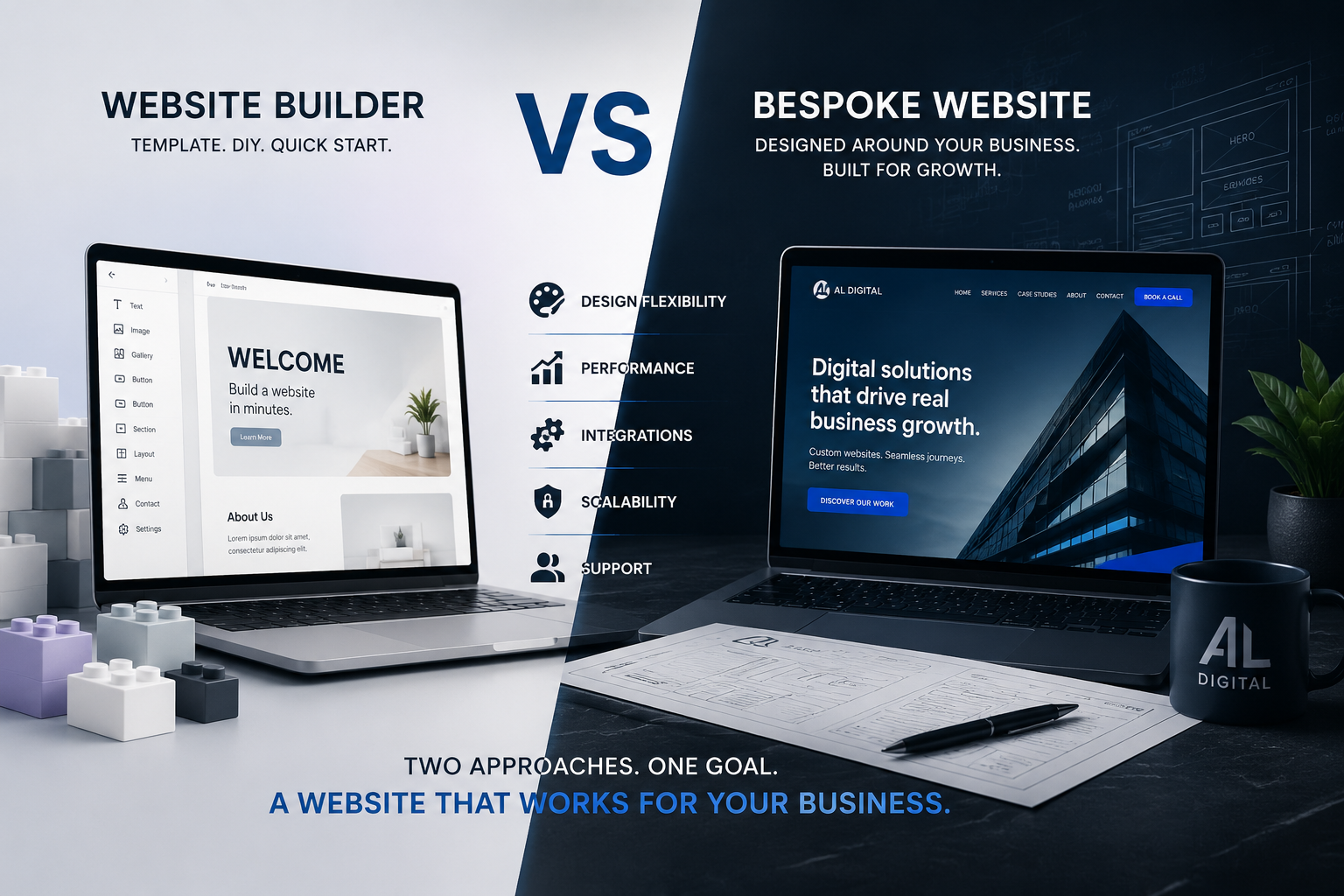
A business website can now be created in more ways than ever.
Platforms such as website builders make it possible to launch a professional-looking site relatively quickly and at a low initial cost.
At the other end of the spectrum, a bespoke website is planned and developed specifically around a business, its customers and the way it intends to grow.
Neither approach is automatically right for everyone.
What does your business actually need its website to do?
This guide compares website builders and bespoke websites across cost, flexibility, SEO, functionality, scalability and long-term business needs.
What Is a Website Builder?
A website builder is a platform that allows users to create a website using pre-built tools, templates and visual editing interfaces.
Popular platforms can make it possible to launch without needing extensive technical knowledge. They are often attractive because they offer:
- low upfront costs
- quick setup
- ready-made templates
- hosting and platform maintenance
- built-in basic features
- relatively simple editing
For a new business, personal project or simple online presence, a website builder for small business can be entirely appropriate.
The important question is whether the platform continues to meet the business’s needs as those needs become more complex.
What Is a Bespoke Website?
A bespoke website is designed around the specific requirements of a business rather than beginning with a fixed template as the primary constraint.
The process usually considers:
- business objectives
- customers and user journeys
- brand positioning
- content structure
- conversion goals
- functionality
- integrations
- technical requirements
- future growth
The result is intended to fit the business rather than requiring the business to fit around the website. That is the central distinction in any custom website vs template comparison.
Website Builder vs Bespoke Website: The Main Difference
The biggest differences usually appear as the business requires greater flexibility, stronger integrations or more control over the customer journey.
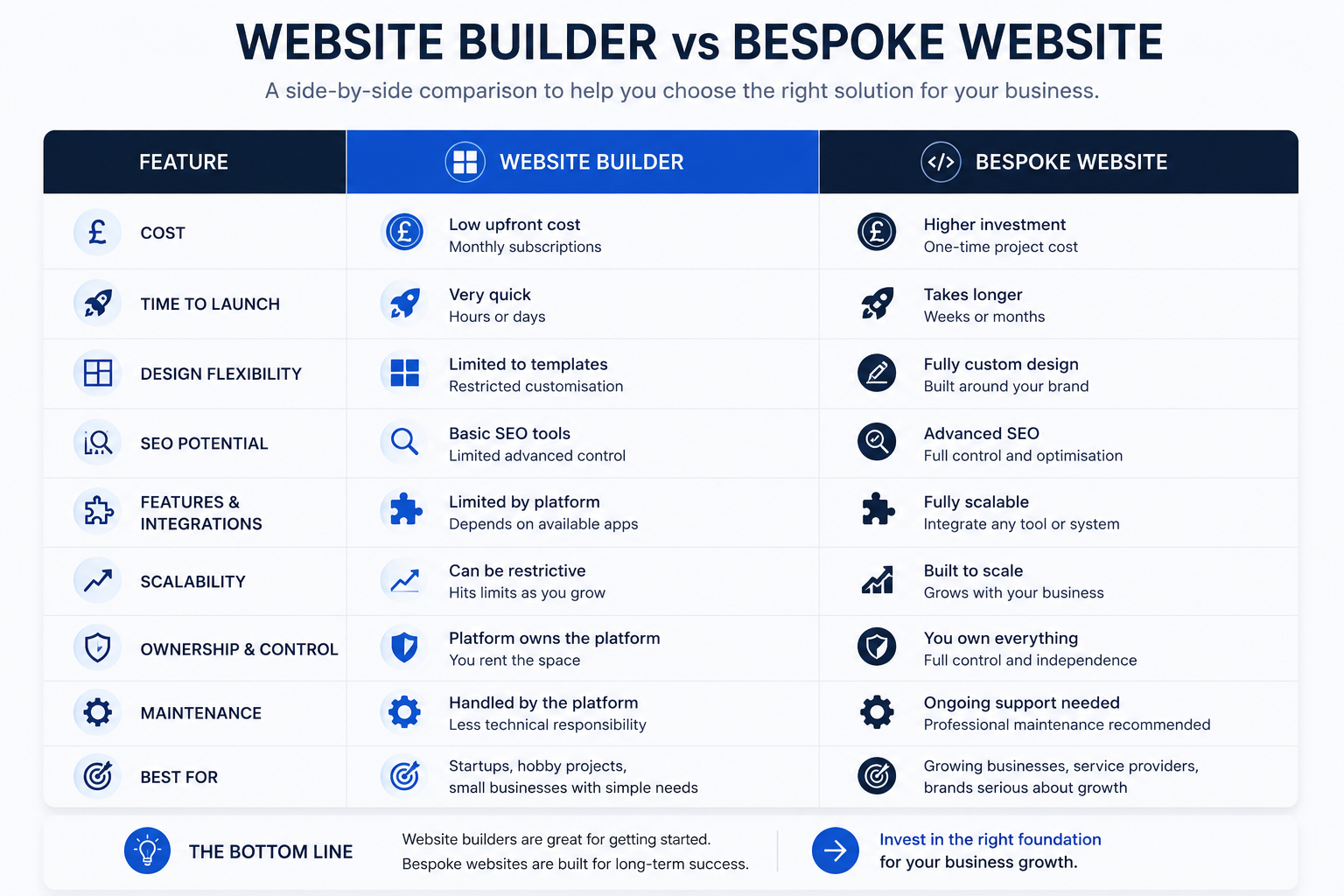
The comparison below summarises the main trade-offs.
Cost
Website builders generally have a much lower initial cost.
Businesses may pay a monthly or annual platform subscription together with additional costs for premium themes, applications, ecommerce features or integrations.
A bespoke website requires a larger upfront investment because strategy, design, development and testing are carried out around the individual project.
That does not mean every business should immediately invest in bespoke development. For a company testing a new idea or requiring a very simple website, a builder may provide better value.
For a more established business where the website contributes directly to enquiries, bookings, sales or operations, the calculation changes.
For a wider breakdown of project investment, read How Much Does a Website Cost in the UK? A 2026 Guide and review AL Digital pricing.
Speed to Launch
A website builder can often be launched quickly because much of the underlying infrastructure already exists. This is useful when speed matters more than extensive customisation.
Bespoke projects generally take longer because additional work may include:
- discovery
- strategy
- customer journey planning
- bespoke design
- development
- integrations
- testing
- optimisation
The longer timeline should therefore reflect additional work and capability rather than simply taking longer to make the same product.
Design Flexibility
Builders provide templates and visual editing tools that can produce attractive websites. However, the design usually operates within the capabilities and structure of the platform.
Bespoke development provides greater flexibility to design around:
- specific audiences
- unique services
- complex navigation
- conversion journeys
- brand differentiation
- unusual functionality
For businesses where digital experience is an important part of the brand, this flexibility can become valuable. This is often the practical issue behind searches comparing a website builder vs web designer or bespoke website design UK.
SEO
Both website builders and bespoke websites can rank in search engines. Using a website builder does not automatically prevent a business from performing well in Google.
Good SEO still depends on factors such as:
- useful content
- clear site structure
- page relevance
- internal linking
- performance
- search intent
- authority
However, bespoke development may offer more flexibility when advanced technical changes, custom structures or performance optimisation are required.
Bookings, Payments and Integrations
A simple website may only need contact information and a basic enquiry form.
As businesses grow, they may require:
- online bookings
- secure payments
- CRM connections
- customer forms
- automated confirmations
- ecommerce
- internal workflows
- external software integrations
Website builders can often provide these through built-in features and third-party applications.
The limitation appears when the business requires systems to behave in a very specific way or multiple tools need to operate as one connected journey. At that point, flexibility and custom website development capability become more important.
Scalability
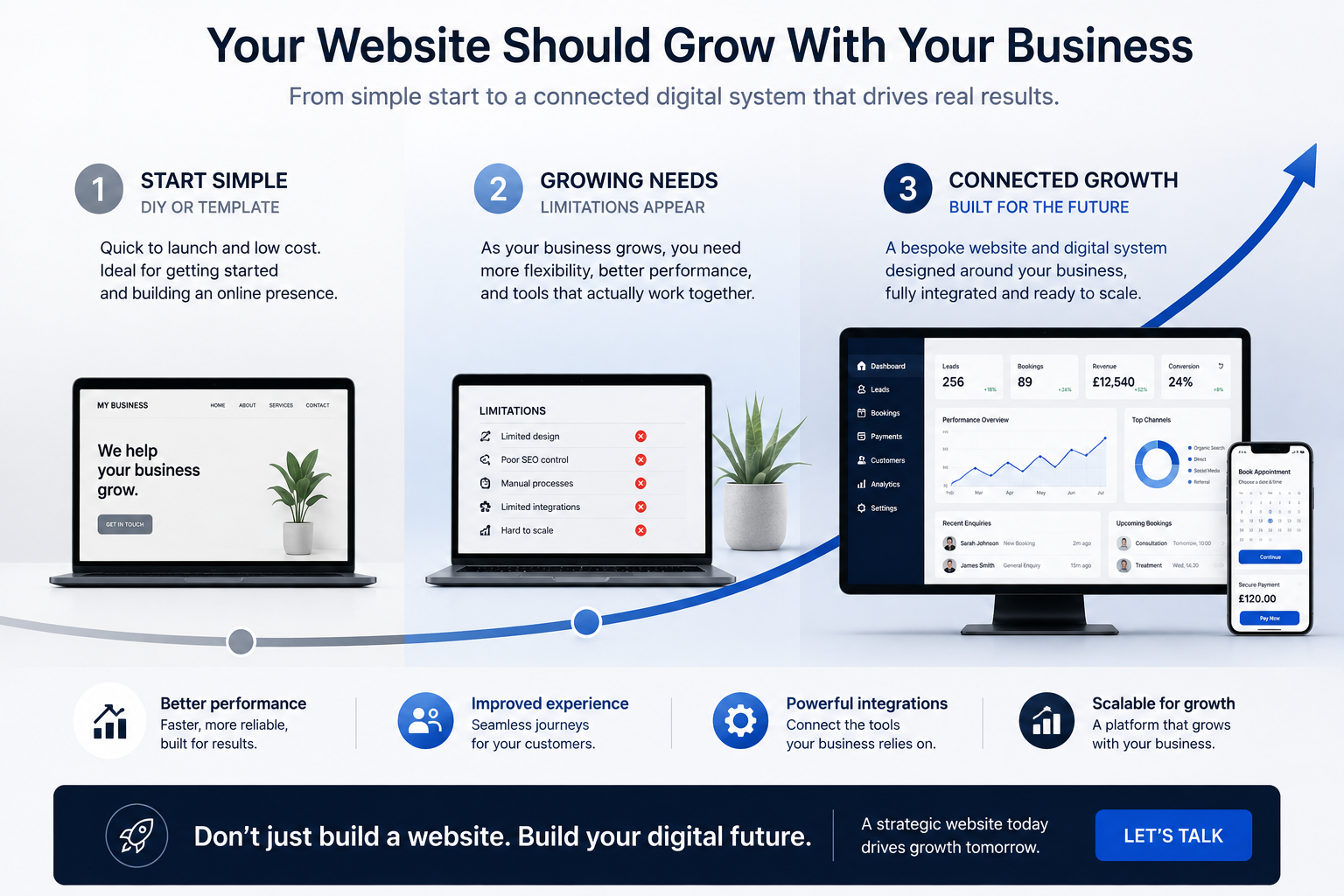
A website that is suitable at launch may not necessarily remain suitable as the business develops.
New services, locations, bookings, payments, automation or integrations can gradually increase what the digital system needs to support.
The important question is therefore not only whether the website works today, but whether it can support where the business is going next.
Who Is a Website Builder Best For?
A website builder may be a sensible choice for:
- new businesses validating an idea
- freelancers requiring a simple portfolio
- small businesses with straightforward requirements
- temporary or campaign websites
- organisations with limited initial budgets
- businesses that do not require complex integrations
Choosing a website builder in these circumstances is not necessarily a compromise. It can simply be the most commercially sensible option at that stage.
Who Is a Bespoke Website Best For?
Bespoke development becomes more relevant when a business needs:
- a differentiated digital presence
- complex customer journeys
- stronger conversion architecture
- bookings or payments
- custom integrations
- automation
- significant service content
- greater control
- scalability
- a website that plays an important role in revenue generation
The business case becomes strongest when limitations in the existing website are beginning to affect growth or customer experience.
When Should You Move Away From a Website Builder?
There is no single point at which every business should move to a bespoke website.
Common signs include:
- repeated platform limitations
- reliance on too many third-party plugins or applications
- difficulty creating the customer journey you want
- integrations that do not work cleanly
- slow or complicated processes
- significant growth in services or locations
- increasing dependence on the website for revenue
- the business has outgrown the original brand or structure
The decision should be driven by commercial requirements rather than simply wanting a more expensive website.
Strategy Matters More Than the Platform
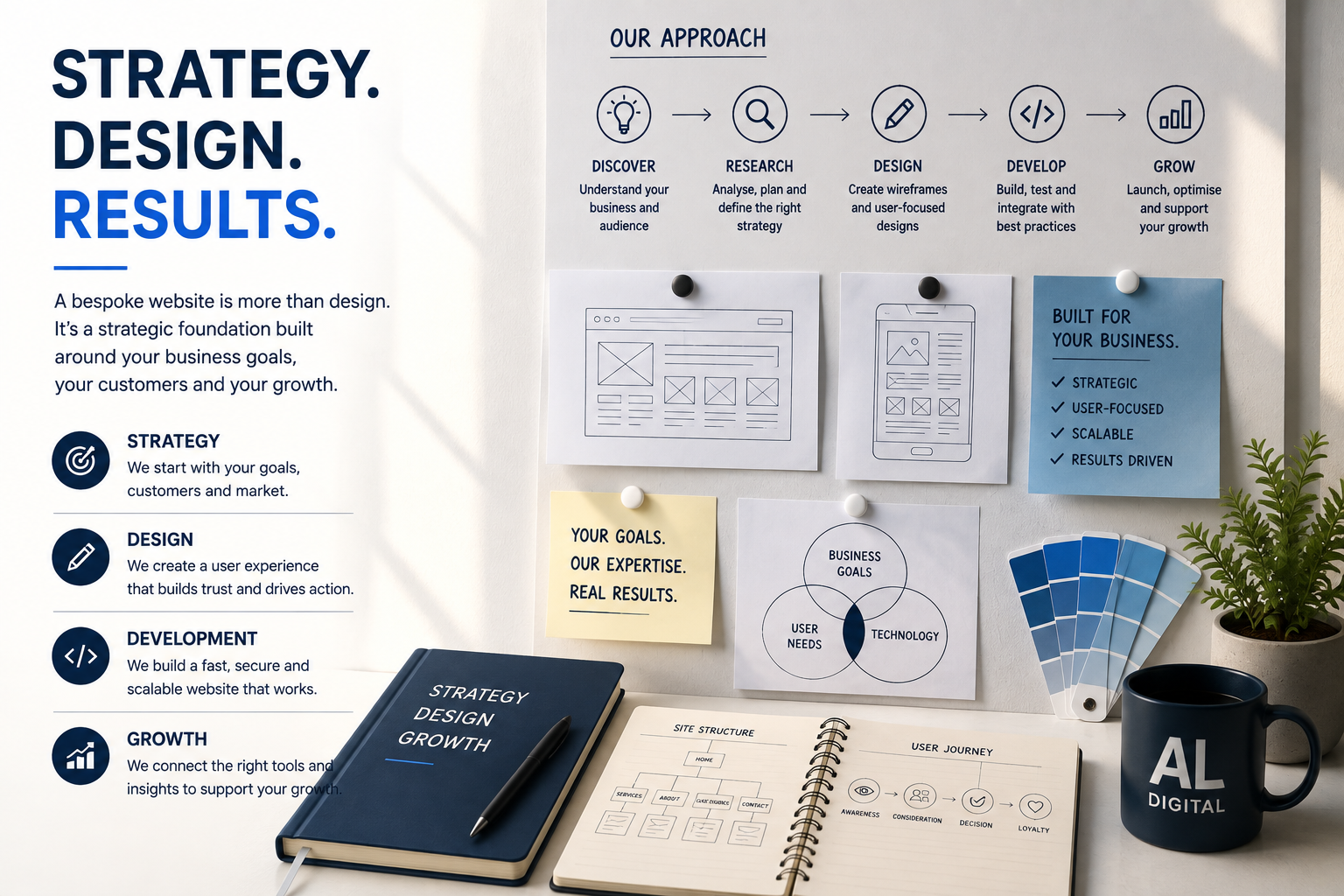
Whether a business chooses a builder or bespoke development, technology alone does not determine whether the website succeeds.
The stronger starting point is understanding:
Who is the customer?
What are they trying to achieve?
What does the business need them to do next?
What systems need to support that journey?
A well-planned website should answer those questions before design decisions are made.
So Which Option Is Right for Your Business?
Choose based on requirements rather than labels.
A website builder may be the better decision if you need:
Speed + simplicity + low initial investment.
A bespoke website may be the better decision if you need:
Flexibility + integration + differentiation + long-term scalability.
Neither should be purchased simply because it is cheaper or more expensive.
The right website is the one that appropriately supports the business at its current stage while allowing sensible room for what comes next.
Explore more practical guidance in the AL Digital Insights hub.
Not sure which route your business needs?
AL Digital can help assess your current website, customer journey and digital requirements before recommending the appropriate approach.
Explore Our Services Get a Free Quote