
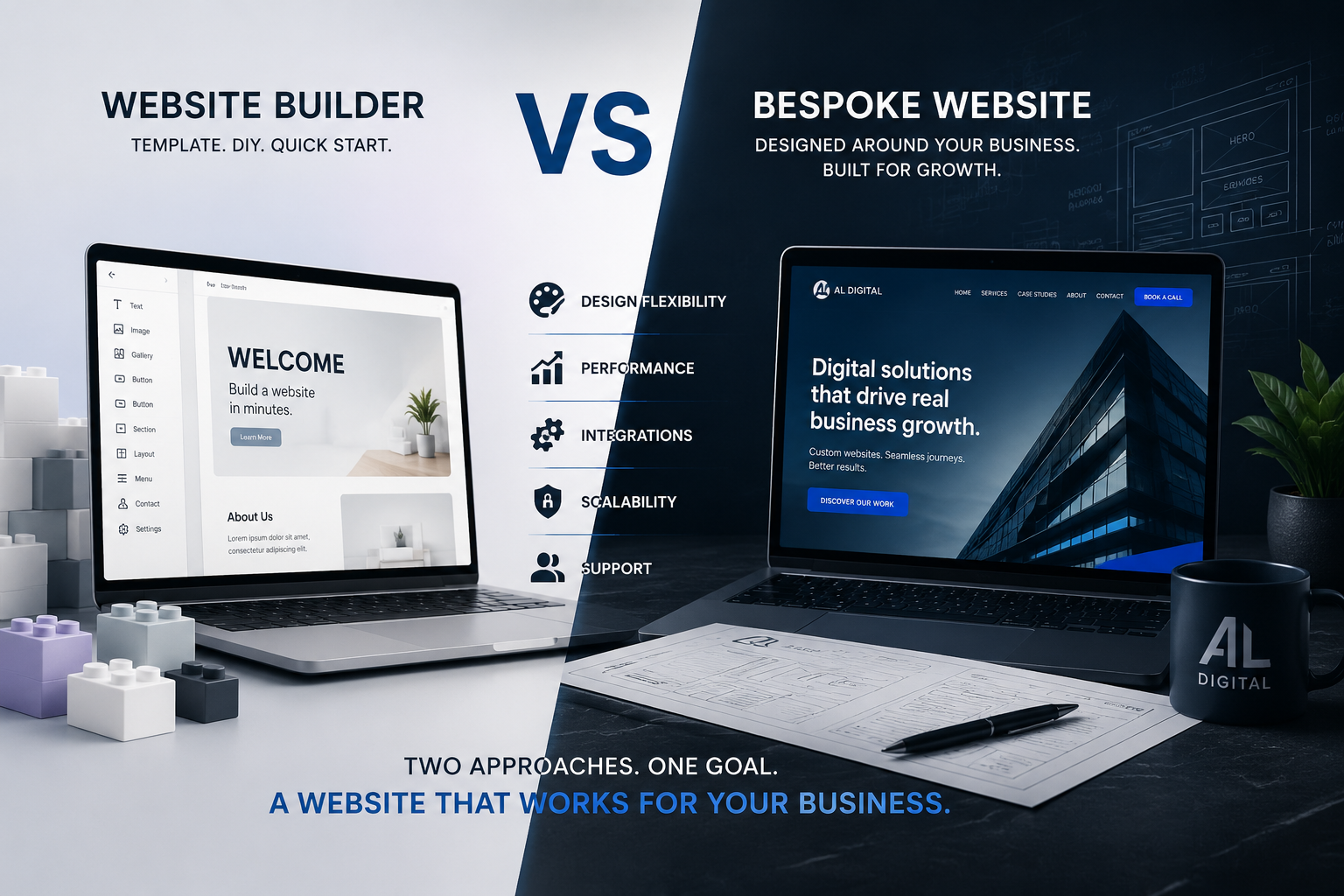
A website can stop supporting a business long before it actually stops working.
It may still load correctly and contain all the expected pages, but the customer journey may feel outdated, important services may be difficult to find, integrations may no longer meet the business’s needs or the underlying technology may be limiting what can be improved.
When that happens, businesses often assume they need a completely new website.
Sometimes they do. But sometimes a focused optimisation or redesign is enough.
Is the problem with the surface of the website — or with the foundation underneath it?
This guide explains when to improve, redesign or completely rebuild a business website.
Improve, Redesign or Rebuild?
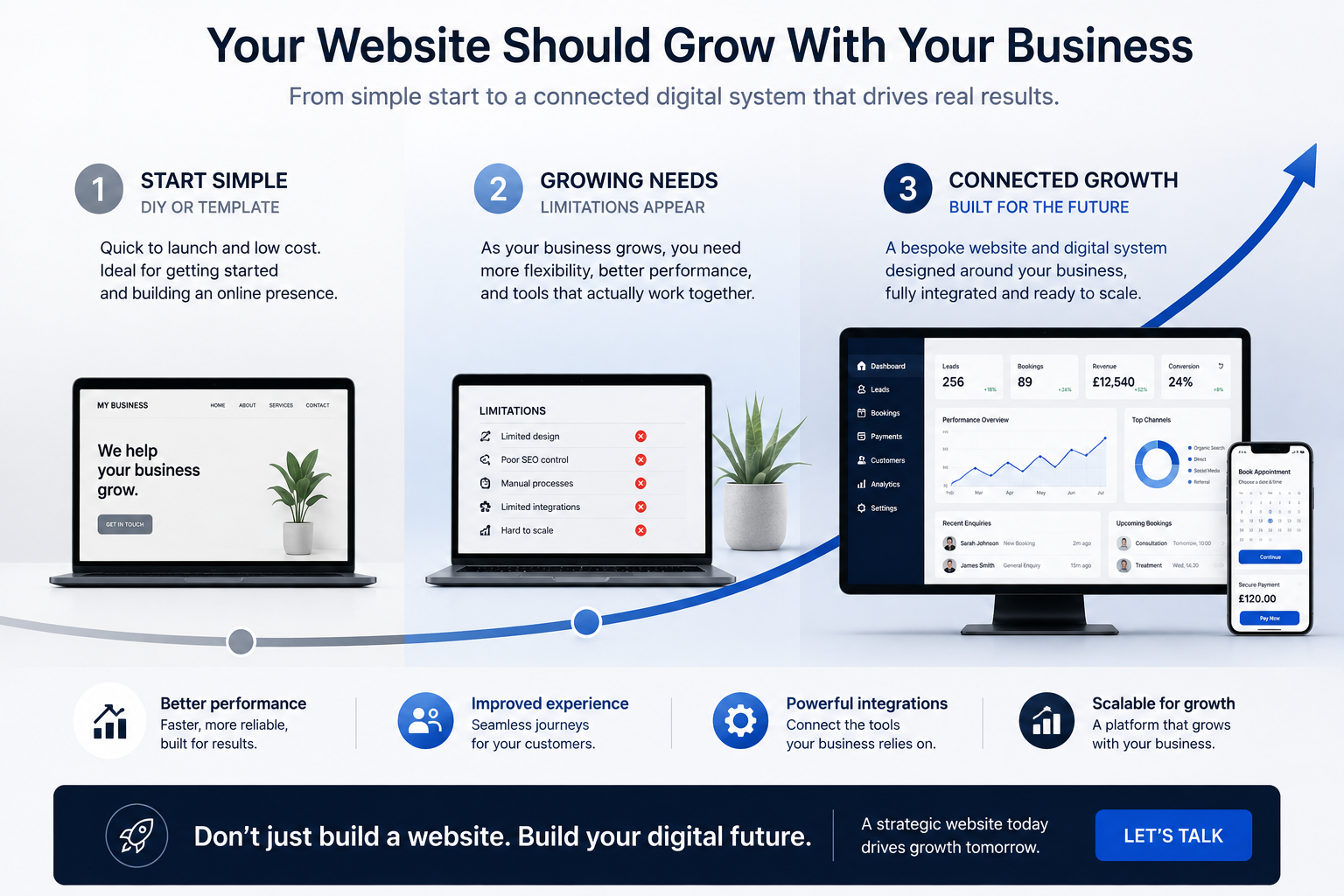
There are generally three levels of intervention. The right choice depends on the platform, customer journey, design quality, performance, functionality, integrations, scalability and business goals.
Improve / Optimise
Keep the existing website and make targeted improvements such as clearer content, stronger calls to action, service-page improvements, better navigation, conversion optimisation, image updates, mobile refinements or performance fixes.
This approach makes sense when the website’s underlying structure and technology are still sound.
Redesign
Keep much of the existing foundation but significantly improve the user experience, presentation and journey. This may involve new layouts, stronger visual hierarchy, revised navigation, improved brand presentation, clearer service architecture and a better mobile experience.
Rebuild
Create a new website foundation when the existing platform, architecture or functionality is fundamentally holding the business back. This may be appropriate when technology is outdated, the site is difficult to maintain, integrations are limited, functionality cannot be added cleanly or security, performance and scalability are problematic.
When Improving the Existing Website Is Enough
A complete rebuild can be unnecessary if the existing foundation is still strong.
Targeted improvements may be enough when:
- pages load reliably
- the CMS is still suitable
- mobile responsiveness is fundamentally sound
- important integrations work
- the page structure makes sense
- the main issues are content, presentation or conversion-related
For example, a website may simply need clearer service pages, stronger calls to action and a better enquiry journey.
In that situation, replacing the entire system may create cost and disruption without solving a fundamentally different problem. Read why a website may not be generating enquiries for practical conversion checks.
When a Redesign Makes Sense
A redesign becomes more appropriate when the foundation still works but the experience no longer represents the business properly.
- dated presentation
- inconsistent branding
- confusing navigation
- weak mobile experience
- unclear page hierarchy
- poor customer journeys
- services added over time without a clear structure
- important calls to action being difficult to find
The purpose of a redesign should not simply be to make the website look newer. It should make the website easier to understand and use.
When a Full Rebuild Is the Better Decision
Sometimes the underlying website itself has become the limitation.
- the platform is obsolete
- technical debt makes changes difficult
- performance is consistently poor
- functionality depends on too many fragile plugins
- important business systems cannot integrate properly
- security concerns exist
- the website cannot scale with new services or locations
- the current architecture no longer matches how the business operates
A new visual design on top of an unsuitable foundation does not solve those problems.
Surface Problems vs Structural Problems
One of the most useful ways to make the decision is to separate visible problems from deeper structural ones.
Surface issues are often cheaper and faster to fix. Structural issues can require a larger investment but may have a much greater long-term effect on what the website can support.
Does Your Website Need Improving, Redesigning or Rebuilding?
Start with the business outcome. Is the website already supporting enquiries, bookings, sales or other important actions?
Then examine whether the remaining limitations sit primarily in content and presentation, the customer experience or the underlying technology.
The decision tree below provides a simple way to assess the situation.
Customer Journey and Conversion
The condition of the technology is only one part of the decision. A technically functional website can still create a poor customer journey.
Review how easily customers can:
- understand what you offer
- find relevant services
- evaluate whether they trust the business
- understand pricing where appropriate
- enquire
- book
- pay
- understand what happens next
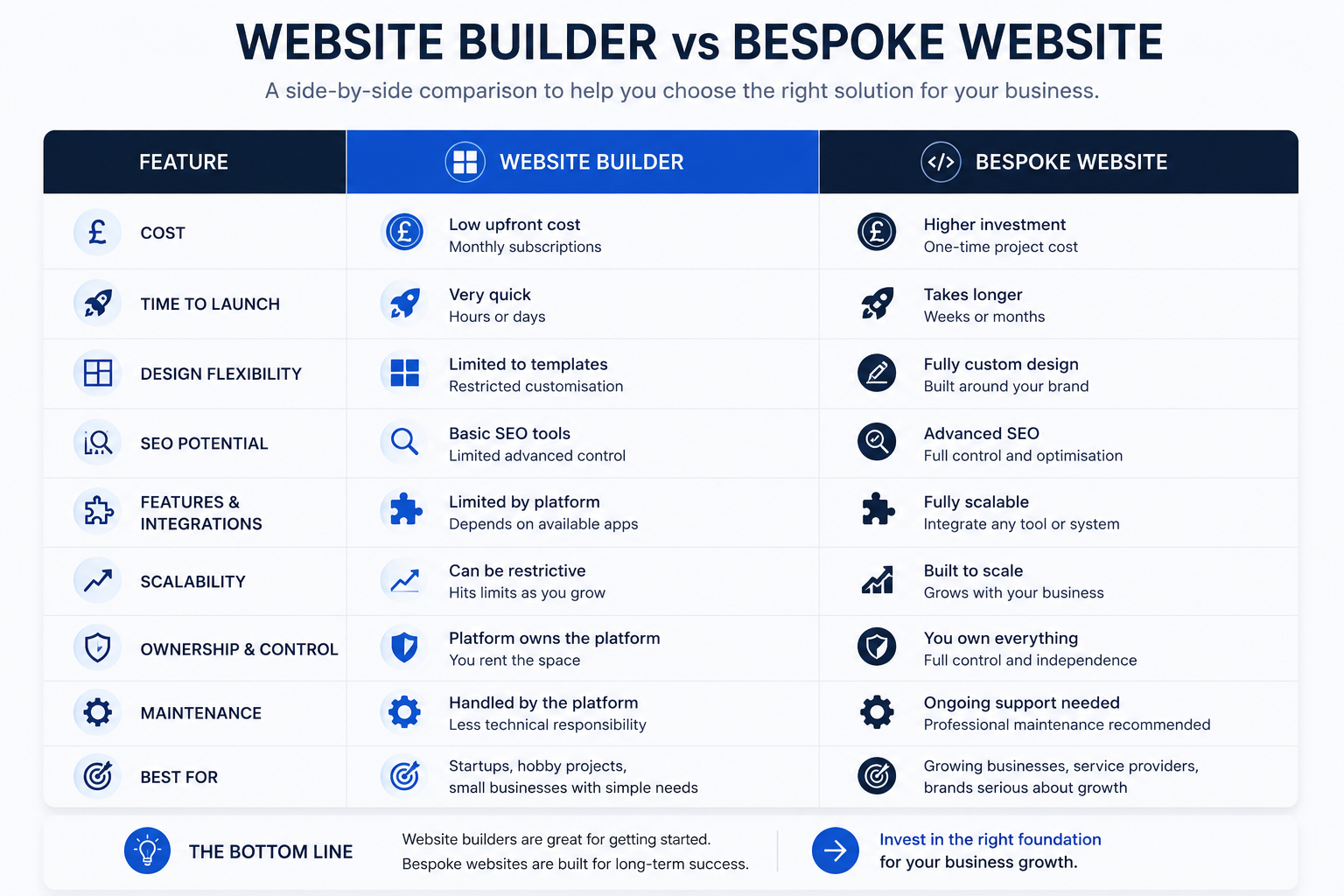
If those journeys can be improved within the existing system, optimisation or redesign may be sufficient. If the current platform makes those improvements difficult or impossible, rebuilding becomes more reasonable. See the comparison of a bespoke website and a website builder.
Technology and Integrations
Modern business websites increasingly connect with booking platforms, payment systems, CRM, ecommerce, customer forms, email automation, analytics, internal workflows and third-party software.
If the existing website can integrate reliably with what the business needs, there may be little reason to replace the foundation.
If every new requirement requires a workaround, additional plugin or manual process, the cost of preserving the existing website can eventually exceed the value of rebuilding properly.
Scalability
Ask whether the website can support what the business is likely to need over the next several years: additional services, more locations, ecommerce, bookings, payments, automation, customer accounts, campaigns, integrations or larger content libraries.
A website does not need every future feature today, but its foundation should not make reasonable future growth unnecessarily difficult.
SEO Considerations When Rebuilding
A website rebuild should be handled carefully from an SEO perspective. Existing pages may already have search visibility, backlinks or established URLs.
- preserve valuable URLs where possible
- implement redirects where URLs change
- maintain useful content and metadata where appropriate
- preserve internal links
- check indexability
- submit updated sitemaps
- monitor Search Console after launch
A redesign or rebuild does not automatically improve Google rankings. Outcomes depend on implementation, content, competition and many other factors.
Cost: Improvement vs Redesign vs Rebuild
Optimisation tends to require the smallest investment. Redesign involves more substantial work. Rebuild typically requires the largest investment because strategy, architecture, design, development, integrations and testing may all be involved.
However, the cheapest short-term option is not always the lowest-cost long-term option. Repeatedly repairing a system that fundamentally cannot support the business may eventually cost more than replacing it.
Likewise, rebuilding a perfectly functional system because the design needs refreshing can waste money. For broader budgeting guidance, read how much a website costs in the UK or review AL Digital pricing.
Before You Rebuild, Assess the Foundation
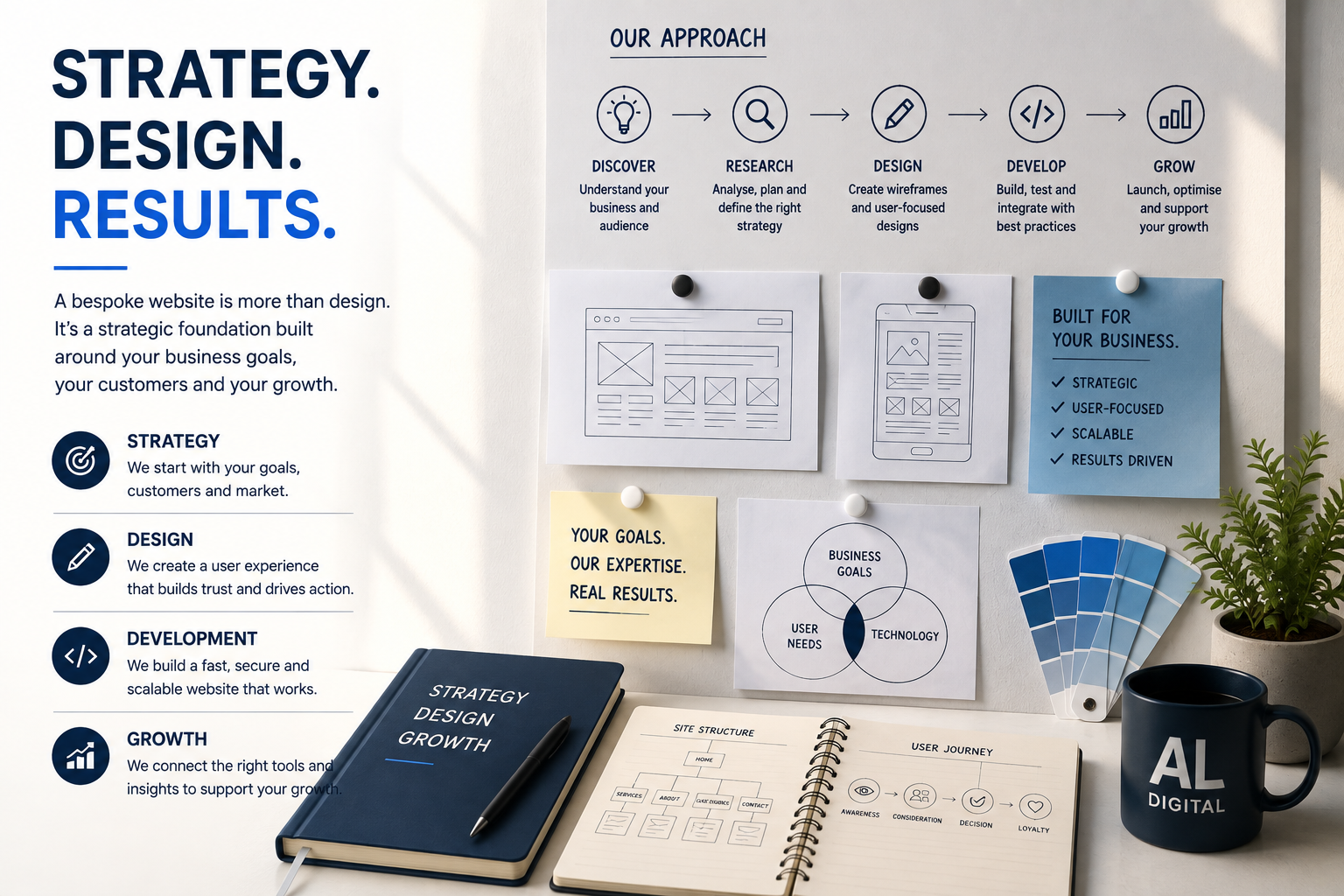
The decision should start with the business rather than the visual design.
Before replacing the website, understand what the new system needs to achieve, how customers use it and which technical requirements genuinely matter.
A strong website is not simply a fresh design. It is a foundation that supports the customer journey and the way the business operates.
Questions to Ask Before Making the Decision
- What is actually wrong with the current website?
- Are the problems visual or structural?
- Does the platform still support our requirements?
- Can the customer journey be improved without rebuilding?
- Are integrations becoming difficult?
- Is the site easy to maintain?
- Does it perform properly on mobile?
- Can it support future services or locations?
- Are we replacing the site because we need to, or simply because it looks old?
- What outcome should the investment create?
A Simple Decision Framework
Improve
The foundation works, but individual elements need attention.
Redesign
The technology and structure remain usable, but the customer experience needs significant improvement.
Rebuild
The underlying platform, architecture or functionality is restricting the business.
The correct decision should solve the real problem rather than simply produce a newer-looking website.
Explore AL Digital’s digital services or browse more practical guidance in the Insights hub.
Not sure whether to improve, redesign or rebuild your website?
AL Digital can assess your current customer journey, website structure and digital requirements before recommending the most appropriate route.
Explore Our ServicesGet a Free Quote